Saints
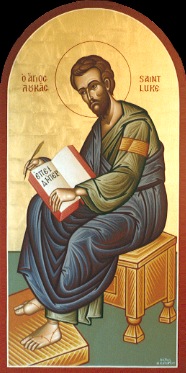
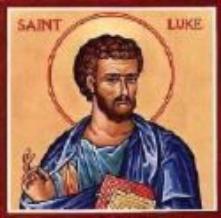
Saint Luke

Luke is the loyal comrade who stays with Paul when he is imprisoned in
Rome about the year 61: "Epaphras, my fellow prisoner in Christ Jesus,
sends greetings to you, and so do Mark, Aristarchus, Demas, and
Luke, my fellow workers" (Philemon 24). And after everyone else
deserts Paul in his final imprisonment and sufferings, it is Luke who
remains with Paul to the end: "Only Luke is with me" (2 Timothy 4:11).
Luke's inspiration and information for his Gospel and Acts came from
his close association with Paul and his companions as he explains in
his introduction to the Gospel: "Since many have undertaken to set
down an orderly account of the events that have been fulfilled among us,
just as they were handed on to us by those who from the beginning
were eyewitnesses and servants of the word, I too decided, after
investigating everything carefully from the very first, to write an orderly
account for you, most excellent Theophilus" (Luke 1:1-3).
Luke's unique perspective on Jesus can be seen in the six miracles
and eighteen parables not found in the other gospels. Luke's is the
gospel of the poor and of social justice. He is the one who tells the story
of Lazarus and the Rich Man who ignored him. Luke is the one who
uses "Blessed are the poor" instead of "Blessed are the poor in spirit"
in the beatitudes. Only in Luke's gospel do we hear Mary 's Magnificat
where she proclaims that God "has brought down the powerful from
their thrones, and lifted up the lowly; he has filled the hungry with good
things, and sent the rich away empty" (Luke 1:52-53).
Luke also has a special connection with the women in Jesus' life,
especially Mary. It is only in Luke's gospel that we hear the story of the
Annunciation, Mary's visit to Elizabeth including the Magnificat, the
Presentation, and the story of Jesus' disappearance in Jerusalem. It is
Luke that we have to thank for the Scriptural parts of the Hail Mary: "Hail
Mary full of grace" spoken at the Annunciation and "Blessed are you
and blessed is the fruit of your womb Jesus" spoken by her cousin
Elizabeth.
Forgiveness and God's mercy to sinners is also of first importance to
Luke. Only in Luke do we hear the story of the Prodigal Son welcomed
back by the overjoyed father. Only in Luke do we hear the story of the
forgiven woman disrupting the feast by washing Jesus' feet with her
tears. Throughout Luke's gospel, Jesus takes the side of the sinner who
wants to return to God's mercy.
Reading Luke's gospel gives a good idea of his character as one who
loved the poor, who wanted the door to God's kingdom opened to all,
who respected women, and who saw hope in God's mercy for everyone.
He is often shown with an ox or a calf because these are the symbols of
sacrifice -- the sacrifice Jesus made for all the world.
Luke is the patron of physicians and surgeons. Sometimes he is
considered a patron of painters of pictures and is often portrayed as painting
pictures of Mary.
St. Luke Prayer
Good Saint Luke,
we are told that before you met our dear Lord
and became a follower of His
and a writer of His Gospel,
you were a doctor.
We beg you this day
to bless and help and protect our doctor.
Obtain for him the graces he most needs
to do his work well and serve God generously.
Help him to be strong and gentle,
prudent and charitable,
understanding and self-sacrificing.
Give him great skill in the care of our bodies,
so that, blessed with physical strength and health,
we may more faithfully perform our daily tasks.
Help us all, good Saint Luke,
to imitate very closely the life
and virtues of our Blessed Mother Mary,
about whom you wrote so beautifully,
and of Him whom she bore into this world,
Jesus Christ our Lord and our God,
who lives and is King for ever and ever.
Amen.

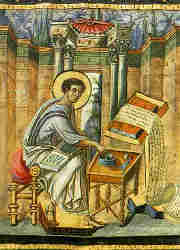
In Luke's account of the Gospel, we find an emphasis on the
human love of Christ, on His compassion for sinners and for
suffering and unhappy persons, for outcasts and for the poor.