Saints
"Oh Lord, Make me good - but not yet!"
This Saint was a partier and a player but turned good int he end.
|
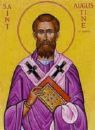
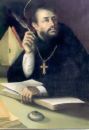
Saint Augustine
"And Thou, O Lord, how long? How long? Is it to be tomorrow
and tomorrow? Why not now? Why not this very hour put an end
to shame?"
These words of repentance marked the beginning of Augustine's new
life. A few years after he came in contact with God, he said, "Our
hearts, O Lord, were made for you, and they are restless until the
rest in you."
Saint Augustine is one of the greatest Fathers of the Church. He
was an original thinker who became recognized as a remarkable
leader of Christian faith. One of the guiding forces in Saint
Augustine's life was his Christian mother, Saint Monica.
Years away from Christ
----------------------
At Carthage, he entered into relations with a woman (to whom he
remained faithful until he sent her away from him 15 years later).
She bore him a son, Adeodatus, in 372. His father had died in 371,
but he continued at Carthage and switched to philosophy and the
search for the truth. He also studied the Scriptures but from a
subjective attitude. He was offended with the simplicity of style,
and could not relish their humility or penetrate their spirit. Then
he fell into Manichaeism - a combination of pagan religions and
philosophy. The darkening of the understanding and clumsiness in
the use of the faculties helped to betray him into his company; and
pride did the rest. "I sought with pride", he says, "what only
humility could make me find. Fool that I was, I left the nest,
imagining myself able to fly; and I fell to the ground."
For nine years he had his own schools of rhetoric and grammar in
Tagaste and Carthage, while his devoted mother, Saint Monica,
spurred on by the assurance of a holy bishop that "the son of so
many tears could not perish", never ceased by prayer and gentle
persuasion to try to bring him to conversion and reform.
In 383 he departed to Rome, secretly, lest his mother should
prevent him from going to the big city. He opened a school or
rhetoric, and then was appointed by the government as a teacher in
Milan, where his mother, and his friend Alipius joined him. Saint's
Monica's only ambition was to convert her son to Christianity.
His Repentance
--------------
In Milan, Saint Augustine came under the influence of Saint Ambrose
the bishop; he began to go to his sermons, not so much with an
expectation of profiting by them as to gratify his curiosity and to
enjoy the eloquence. He found that the discourses more learned than
the heresies he adopted and began to read the New Testament
especially Saint Paul's writings. In the same time, the mother of
Adeodatus his son left back to Africa leaving the child behind.
Saint Augustine's spiritual, moral and intellectual struggle went
on; he was convinced of the truth of Christianity, but his will was
weaker than the worldly temptations, and delayed his return to
Christ for many months. "Soon, in a little while, I shall make up
my mind, but not right now" he kept telling himself. In his half
desires of conversion he was accustomed to beg of God the grace of
chastity, but was at the same time in some measure afraid of being
heard too soon. He realized that his problem was a moral one. The
Divine truth for which he was seeking would never be his unless he
first overcame his weakness.
Soon after, Pontitian, an African, came to visit Saint Augustine
and his friend Alipius; he told them about two men who had been
suddenly turned to the service of God by reading about the life of
Saint Anthony. His words had a powerful influence on the mind of
Saint Augustine. He was ashamed his will has been so weak and said
to Alipius:
"What are we doing to let the unlearned seize Heaven by force,
whilst we with all our knowledge remain behind, cowardly and
heartless, wallowing in our sins? Because they have
outstripped us and gone before, are we ashamed to follow them?
Is it not more shameful not even to follow them?"
He rushed to the garden, greatly upset; tears filling his eyes, he
threw himself on the grass under a fig tree and reproached himself
bitterly crying out:
"And Thou, O Lord, how long? How long? Is it to be tomorrow
and tomorrow? Why not now? Why not this very hour put an end
to shame?"
As he spoke these words he heard a child's voice singing "Tolle
lege! Tolle lege!" (Take up and read! Take up and read!). He could
not remember any childhood game he played with any such words. He
remembered that Saint Anthony was converted from the world by
hearing a single verse. He took up Saint Paul's epistles and read
the first chapter that met his eyes: "Let us walk honestly, as in
the day; not in rioting and drunkenness, not in chambering and
wantonness, not in strife and envying. But put ye on the Lord Jesus
Christ, and make not provision for the flesh, fulfil the lusts
thereof." (Romans 13:13-14)
When he told Alipius what he had experienced, Alipius took the book
and read, he found the next words to be: "Him that is weak in the
faith receive ye" and applied them to himself and joined his friend
in his resolution.
This high point in the conversion of Saint Augustine took place in
the September of 386, when he was 32 years old. He, his son
Adeodatus and Alipius were baptized by Saint Ambrose at Easter the
following year in the presence of saint Monica. She knew that her
prayers were answered and died shortly after. Saint Augustine
prayed:
"Too late, have I loved Thee, O Beauty so ancient and so new,
too late have I loved Thee! Thou wast with me, and I was not
with Thee; I was abroad, running after those beauties which
Thou hast made; those things which could have no being but in
Thee kept me away from Thee. Thou hast called, Thou hast cried
out, and hast pierced my deafness. Thou hast enlightened, Thou
hast shone forth, and my blindness is dispelled. I have tasted
Thee, and am hungry of Thee. Thou hast touched me, and I am
afire with the desire of thy embraces."
A Priest and then a Bishop
--------------------------
From that time, Saint Augustine went back to Tagaste, his native
city, and lived for three years with his friends and shared a life
of prayer, study and poverty. All things were in common and were
distributed according to everyone's needs. He had no idea of
becoming a priest, but in 391 he was ordained as an assistant to
Valerius, Bishop of Hippo, and he had to move to that city.
He established a sort of monastery in his house, living with Saint
Alipius, Saint Evodius, Saint Possidius and others according to the
rule of the holy Apostles. Valerius who had ann impediment in
speaking appointed Saint Augustine to preach in his own presence
and he has not interrupted the course of his sermons until his
death (nearly 400 sermons). He vigorously opposed the Manicheans
and the Donatists.
In 395 he was consecrated bishop as coadjutor to Valerius, and
succeeded him in the see of Hippo on his death soon after. He
established regular and common life in his episcopal residence, and
required all the priests, deacons, and subdeacons to renounce
property following the regular mode of life recognized by the early
Church as instituted by the Apostles.
He founded a community of religious women and on the death of his
sister, the first "abbess", he addressed a letter on the general
ascetic principles of the religious life; this letter is known as
the "Rule of Saint Augustine".
He employed the revenues of his church in relieving the poor and in
redeeming the captives. Like another Moses or Saint Paul, he said
to his people: "I do not want to be saved without you. What shall
I desire? What shall I say? Why am I a bishop? Why am I in the
world? Only to live in Jesus Christ: but to live in Him with you.
This is my passion, my honor, my glory, my joy and my riches."
There is a god example of Saint Augustine's modesty and humility in
his discussion with Saint Jerome over the interpretation of a text
of Galatians. Owing to the miscarriage of a letter Saint Jerome,
not an easily patient man, deemed himself publicly attacked. Saint
Augustine wrote to him: "I entreat you again and again to correct
me confidently when you perceive me to stand in need of it; for
though the office of a bishop be greater than that of a priest, yet
in many things Augustine is inferior to Jerome."
Through his 35 years as a bishop of Hippo, Saint Augustine had to
defend the faith against one heresy or another. He opposed the
Donatists, the Pelagians, and the Alarians. In order to finish his
valuable writings, and to provide against a troublesome election
after his death, he proposed to his clergy and people to choose for
his coadjutor Heraclius, the youngest among his deacons, and his
election was confirmed by acclamation in 426.
Saint Augustine calmly resigned his spirit into the hands of God on
August 28, 430, after having lived 76 years and spent almost 40 of
them in the labors of the ministry. Among his greatest work is the
15 volume "On the City of God" which took him 30 years to write,
and his "Confessions".
May the prayers and supplications of the great Saint Augustine be
with us. Amen.
SEE! There is hope for everyone!