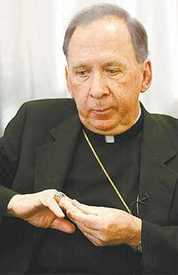
In a nutshell:
Convicted for, over three decades, knowingly & actively hiding & protecting priests guilty
of sexually abusing children.
In exchange for immunity made a plea deal admitting guilt for his participation in what
prosecutors already had considerable documentation of.
Afterwards made a public statement saying that he was not guilty of any wrongdoing
and was still fit to lead the Catholic Church.
Convicted of hit & run - killed the man and drove off, hid his car in the garage and the
next morning asked his secretary to make an appointment with a body shop to have his
car repaired.
Later said he thought that perhaps he had hit a dog.
He received four years probation and community service work.
A few months in to his probation asked that sentence be lightened so he could travel.
All the while insisting that he was morally fit to lead the church and refused to step down.
Read more if you must. It's pretty depressing......
Bishop Thomas O'Brien at the Edge of a Cliff
The Arizona Republic [Phoenix AZ]
January 14, 2003
It was the worst possible excuse a parochial school miscreant could come up with, so naturally I used it
all the time. "It wasn't just me," I'd tell an unflinching nun. "Everybody was talking (or chewing gum or
scribbling answers on the palms of their hands)." Not only would I get the lecture about the lemmings,
as in, "If everyone was jumping off a cliff, would you do that, too?" I also got, "Did Jesus do what
everyone was doing, or did he stand alone and do the right thing?" At the time, I couldn't point to the
lemming like example of the Catholic bishops, including our own Bishop Thomas O'Brien.
But that has changed. After months of sad revelations, the only argument O'Brien can make on his own
behalf is that, years ago, transferring potentially dangerous priests from parish to parish and urging
victims and their families not to come forward was acceptable. In fact, everybody was doing it.
A survey published in the New York Times over the weekend provided examples from Catholic
dioceses all over the country. Phoenix and Tucson were not immune. Not only did priests like O'Brien
shelter fellow priests and try to keep victims quiet, but police agencies tended to side with the clergy.
And so did society in general, which didn't want to believe priests or church workers would do such
things.
So we need to ask ourselves: After all these years, should we blame O'Brien for not bucking the
system? For not standing up against the hierarchy of his own church and the authorities on the
outside? For not doing the right thing when he might have had to stand alone? Yes.
There was a time when segregation was acceptable and denying people their civil rights was perfectly
OK. Some of the first men and women to defy that policy were Catholic priests and nuns. Likewise,
when abusing laborers was the accepted law of the land, it was Catholics like Dorothy Day who fought
to change it. Just as it was Catholic clergy who stood up for poor people in this country and in Latin
America. And Catholic clergy who publicly said the Vietnam War was wrong at a time when just about
everyone else was saying it was right.
If a grade school punk can't get away with using a tired old excuse like "everybody was doing it," how
can a man of the cloth?
The only other argument that Bishop O'Brien has in his favor is that he doesn't remember doing
anything wrong. But that doesn't wash. O'Brien has been accused by several victims and family
members of transferring priests who were known sex offenders. "The bishop himself called me
after I reported my children had been molested and said, 'Betty, you need to stop. You
need to be quiet,' " said Betty Shannon, mother of three abuse victims.
The victim of ex-priest John Giandelone made the same claims. That victim's lawyer said, "Nobody
should be above the law. Father Giandelone will have to respond to the law for what he did, and the
bishop will have to be accountable for what he did back in 1980 in connection with telling the family not
to tell anybody and essentially covering it up."
Not only are O'Brien and others said to have pressured victims and their families to keep quiet, but at
least twice judges gave in to requests from O'Brien and reduced plea bargains made with sexually
abusive priests. Sometimes going against recommendations of professional counselors.
O'Brien has said he doesn't remember telling families not to come forward.
Unfortunately for him, the families remember.
And he can't deny asking for leniency. He can only say, again, that everybody was doing such things at
the time.
To paraphrase a stern nun's question to a wayward Catholic schoolboy, "If all the other priests were
jumping off a cliff, would you do that, too?"
Abuse victims feel O'Brien was 'let off hook criminally'
By Connie Cone Sexton
Arizona Republic
June 3, 2003 12:00 AM
http://www.azcentral.com/news/articles/0603church-victims.html
Bishop Thomas J. O'Brien should have been indicted and not allowed immunity for admitting he
covered up sexual abuse cases in the Phoenix Diocese, victims of the abuse and their families said
Monday.
"He truly should be held accountable and sent to jail for what he's done," said Glendale resident Shari
Roy, who gave birth to a child in 1978 after she said she was raped by former Scottsdale priest
Patrick Colleary.
"O'Brien is as evil as the predators" for not bringing to public light the actions of his priests, she said.
Kathleen Lecheler, another of Colleary's accusers, agreed: "I'm real disappointed he's being let off the
hook criminally. The buck stops there. He needs to pay the price."
Lecheler, who claimed that Colleary had fondled her as a child while serving at SS. Simon and Jude
Cathedral, winces when she recalls that O'Brien previously had said his conscience was clear. She
said she had gone to O'Brien for help years ago about Colleary but was rebuffed. "I felt very patronized
and very frustrated. I had even sent in a letter with all the details."
Paul Pfaffenberger, who founded the local chapter of SNAP (Survivors Network for those Abused by
Priests), said the agreement signed by O'Brien leaves "unfinished business. His being met with
criminal consequences would have been more satisfying to the victims."
Still, Pfaffenberger said he understood why Maricopa County Attorney Rick Romley made the deal he
did and he's impressed with his tenacity at landing the agreement.
Family members of those who have been abused said O'Brien's admission helps bring closure but it's
not enough.
Sue Watson, whose son Sean was molested by the then-Father George Bredemann at St. Catherine
of Sienna Church in Phoenix, wanted O'Brien to be held fully accountable. Bredemann, who has been
defrocked, was given 45 years in prison in 1989 for having had sex with young boys.
"It's just such a slap in these kids' faces," she said. "That there are no charges against the bishop is
just unbelievable to me when you think about the crimes that have been committed in this Valley. My
son suffered. He became a drug addict, but he's clean now."
Sean, now 31 and working as a disc jockey in Kansas, said it is "ridiculous" that O'Brien is basically
staying put on the job. "It does bring some closure to this in that he admitted what he knew, but I don't
agree with the doctrine.
Sean said he would like to sit down with O'Brien and get an answer for why he didn't come forward
years ago. "It would be a pretty deep conversation. There'd be some anger, but I'd love to ask him
why."
Phoenix resident Rene Sosa, who claims he was victimized by now-deceased priest Henry Perez,
said O'Brien needs to make a public apology.
Sosa, 38, who said he was abused from the ages of 12 to 15 by Perez at St. Matthew Catholic Church
in Phoenix, said Perez was "like a demon who wouldn't go away. But today, I heard that he had died. I
can have closure now. But I think O'Brien should really represent the people he represents in the
church. He owes us an explanation."
Lecheler, 46 and living in Austin, is glad the agreement O'Brien signed provides funds for victims
counseling.
But she said there isn't enough money to heal her feelings of loss with the Catholic Church. While her
faith in God remains steadfast, she feels abandoned by her religion.
"It was my cornerstone, and that's the biggest thing now. I just haven't gotten that back. It's almost like a
big sham. Where do I have to go to have my faith?"
Contact information
Contact information for victims of possible sexual abuse by priests:
Maricopa County Attorney's Office: (602) 506-4200.
SNAP: Survivors Network for those Abused by Priests: (480) 600-7811.
Romley, O'Brien clash over substance of deal
Bishop denies he's admitting cover-up
Joseph A. Reaves joseph.reaves@arizonarepublic.com
Arizona Republic
June 3, 2003
http://www.azcentral.com/news/articles/0603church-main03.html
An immunity agreement intended to bring an end to the lingering sex abuse scandal in the Phoenix
Diocese turned instead into another dramatic showdown Monday between Bishop Thomas J. O'Brien
and County Attorney Rick Romley.
The bishop and prosecutor took sharply differing stands about the meaning of the agreement, which is
believed to be the first negotiated by a senior Catholic Church leader to avoid possible criminal
indictment in connection with covering up sexual abuse.
O'Brien insisted that a key 82-word statement he signed in return for immunity
from prosecution fell far short of an admission that he covered up sex crimes by
priests in the Phoenix Diocese and endangered children.
"I certainly never intentionally placed a child in harm's way," O'Brien said at a news
conference Monday afternoon.
"To suggest a cover-up is just plain false. I did not oversee decades of wrongdoing."
Romley reacted angrily to the bishop's remarks.
"Is he revising history?" Romley said.
"Did the bishop fail to understand the confession he was signing? Did he fail to understand that he
needed immunity? If he continues to lie about everything, I'll have to consider whether or not that's a
breach of our agreement."
The sparring came at the end of a day that began with Romley announcing the immunity agreement, a
statement of responsibility by the bishop and the indictment of six priests who served in the Phoenix
Diocese.
Those six indictments were the result of a yearlong investigation by several grand juries
that examined more than 200,000 documents and the personnel records of 70 priests,
former priests and church employees accused of sexual misconduct during the past
three decades.
Romley said at his morning news conference that the criminal indictments and a five-page legal
agreement the bishop signed had effectively brought an end to his investigation.
That legal document gives O'Brien immunity if he adheres to 14 conditions, some of which eliminated
the bishop's authority to deal with sexual abuse cases in the diocese.
Other points in the agreement imposed significant financial settlements on the diocese and required
the bishop to revamp the church hierarchy by bringing in three new officials.
A moderator of the Curia, the equivalent of a chief of staff, will be named to assist in the day-to-day
running of the diocese.
An independent advocate and a new attorney will be hired to deal specifically with sex abuse
allegations.
Church attorneys have delivered a $400,000 check to cover those costs.
In addition, the diocese agreed to donate another $100,000 a year for three years to provide
counseling for victims of child sexual abuse and to guarantee up to $50,000 apiece for any victims or
their family members who request treatment.
Those concessions were coupled with a statement from O'Brien in which the bishop acknowledged he
knowingly allowed priests under his supervision "to work with minors after becoming aware of
allegations of sexual misconduct."
The bishop further acknowledged in the statement "that priests who had allegations of sexual
misconduct made against them were transferred to ministries without full disclosure to their supervisor
or to the community in which they were assigned."
Romley said those admissions and other evidence he gathered during his
investigation convinced him that he had the evidence to bring a felony criminal
indictment against O'Brien for obstruction of justice.
The county attorney said he decided against seeking an indictment only after getting what he
considered to be a candid confession from O'Brien and a promise that the bishop would surrender all
power to deal with sex abuse allegations in the diocese.
"I could have brought charges," Romley said at his news conference. "But I felt my primary goal was to
protect the children. I chose the future rather than dwell on the tragedies of the past."
Early Monday, before Romley released the text of the agreement, three of his top aides met with 16
victims of sexual abuse and their families to let them know about the immunity deal and what it
involved.
Several participants said that when the terms of the deal were announced, the victims and their
families broke into applause.'
"It was amazing," said Paul Pfaffenberger, head of the local chapter of SNAP, the Survivors Network
of those Abused by Priests. "Romley and his staff did a phenomenal job."
Not everyone agreed. The county attorney was harshly criticized by many who felt he was applying a
double standard if, as he claimed, he had enough evidence to indict O'Brien.
"Why isn't the bishop in jail?" said Father Thomas Doyle, a priest for 33 years and an
internationally recognized expert on sex abuse in the church.
"If this happened to anybody else, the perks and privileges of his office
would not have kicked in. To see one of these guys convicted would
show them they are no longer above the law. That's going to make a big
difference."
Michael Manning, who represented O'Brien and the diocese for several months last year, disagreed.
He thought the agreement Romley negotiated, and the statement the county attorney got from the
bishop, were significant.
"I think he did a good job, and I think he acted very responsibly in a very difficult investigation,"
Manning said.
Father Thomas Reese, editor of America, the Catholic weekly magazine, and an expert on church
affairs, hailed the agreement Romley announced.
"What the county attorney has done with this agreement is to make sure that the diocese cleans up its
act, which would not necessarily have been brought about simply by an indictment," Reese said. "This
is an unprecedented kind of an agreement because the bishop agrees to allow specific people in the
diocese to make decisions in areas where he normally would have the final say."
Romley was adamant that the immunity agreement, and the concessions he negotiated with the
diocese, would do more to help the church and the community move past the sex abuse scandal than
indicting the bishop:
"Somewhere the church lost its moral compass. This is so wrong. I don't understand how this
could happen. They need to get their moral compass realigned and get back to doing the good they
have done in the past."O'Brien met with priests from the diocese at a retreat Monday afternoon, shortly
after Romley's news conference announcing the agreement.
Several priests attending the retreat expressed shock at the bishop's statement when they first heard
the news, but then dramatically changed their minds after hearing what O'Brien had to say.
The Diocese of Phoenix
Founded: 1969, created from the dioceses of Tucson and Gallup, N.M.
Leadership: Thomas J. O'Brien is its third bishop, succeeding James A. Rausch, who died in 1981.
The diocese's first bishop, Edward A. McCarthy, was reassigned to Miami.
Size: An estimated 560,000 Catholics reside in metropolitan Phoenix. The Church of Jesus Christ of
Latter-day Saints ranks second with 160,000 members, followed by the Southern Baptist Convention
with 84,000.
Operations: A combined 89 parishes, 27 missions and 33 schools in Maricopa, Mohave, Yavapai and
Coconino counties. Does not include the Navajo Reservation or the Gila River Reservation.
O'Brien won't surrender power
Joseph A. Reaves joseph.reaves@arizonarepublic.com
Arizona Republic
June 4, 2003
http://www.azcentral.com/specials/special16/articles/0604church-main04.html
Bishop Thomas O'Brien took significant steps Tuesday to implement terms of a deal he signed to
avoid criminal prosecution. But he made it clear he would reject any attempts to diminish his authority.
"The bishop is still the bishop," O'Brien said during a 29-minute interview at the new diocesan
headquarters in downtown Phoenix.
"(As bishop) you can't step down. You cannot abdicate."
O'Brien's forceful stand came in response to questions about his immunity agreement made public on
Monday.
Maricopa County Attorney Rick Romley said the five-page document compelled O'Brien to surrender
authority to handle any allegations of sexual misconduct.
Romley said the diocese will hire a new independent youth protection advocate to coordinate sexual
abuse policies with the help of a new independent attorney. The two will report to a moderator of the
Curia, a newly established position for the person who will essentially be O'Brien's chief of staff.
O'Brien invited reporters to his office to introduce two of the three new officials: Jennifer O'Connor,
youth protection advocate, and Monsignor Richard Moyer, moderator of the Curia.
While discussing their roles, O'Brien rejected any notion he was yielding the ultimate authority to deal
with sex abuse allegations.
"I can't abdicate my responsibility," he said. "I'm not relinquishing my authority. But at the same time I
am delegating. That perhaps is a thin line that many people may not understand. But I understand it,
and the people who I delegate to understand it."
The bishop's words clearly were carefully chosen, and three of his top legal advisers stood nearby,
carefully listening to ensure that the words came out just right.
O'Brien made a point of distinguishing between "delegating" responsibility and "relinquishing"
authority.
That distinction was in line with a key provision of the immunity agreement, which read: "Certain
administrative duties have been delegated by Thomas J. O'Brien to the moderator of the Curia."
Those duties include responsibility for enforcing the church's sexual misconduct policy.
On Monday, Romley had said the 14-point agreement effectively removed O'Brien from having
anything to do with sexual abuse allegations in the diocese.
"I have attempted to take the authority over sexual abuse allegations away from Thomas O'Brien,"
Romley said. "He is out of the picture."
Romley vowed to go to court to revoke the immunity agreement if O'Brien ever again became involved
in handling sexual misconduct cases.
But the bishop insisted Tuesday that no civil authority could strip him of ultimate responsibility for
church policies, including the monitoring of sexual misconduct accusations.
"I have to know what is going on," O'Brien said. "If a priest abuses a child, I have to know that. You
wouldn't want me not to know about that, would you? I would have to know because I would have to
take them out of the ministry."
O'Brien said he will rely on his new aides to determine the credibility of sexual abuse allegations and
will act on their recommendations. That has been his policy for more than a decade, he said, and it will
not change.
"That's been the case for the last 14 years," he said. "Other people made judgments about the
credibility of allegations. I have not done that. But when they come to me and say, 'Bishop, there's
evidence that this man has abused a child,' then I take action."
"I apologize to anyone I might have harmed by my actions or by the actions of any diocesan
personnel," he said. "I regret that very deeply."
O'Brien seemed to invoke careful semantics in discussing the key part of his immunity agreement.
In an 82-word statement, he acknowledged allowing priests accused of sexual
misconduct to work with minors and admitted transferring priests facing sexual
allegations without notifying their superiors or the community.
"I did not intentionally assign a priest to a parish where I knew, believed or thought he would offend,"
O'Brien said Tuesday. "That's in my heart. That's what I believe to be true."
The bishop was asked whether he used the word "knowingly" to set that comment apart from the
statement he signed in the immunity agreement.
"I don't know, but I know what is in my heart," he said. "I don't know that I knowingly developed a
scheme, had a cover-up or tried to transfer a priest when I knew this guy was going to offend again. I
believe in my heart that he would not."
Romley was unavailable for comment Tuesday night but reacted angrily earlier when he heard similar
remarks from O'Brien maintaining his innocence.
"I am reviewing all of the comments from Bishop O'Brien," Romley said.
"I am very disappointed that he is failing to acknowledge the tragedies of the past. I will
be much more willing to bring forward criminal charges in the future."
Valley stunned by arrest of O'Brien in fatal hit-and-run
By Dennis Wagner, Judd Slivka and Joseph Reaves
Arizona Republic
June 17, 2003
http://www.azcentral.com/arizonarepublic/news/articles/0617obrien-main17.html#
Bishop Thomas J. O'Brien, beleaguered by a sexual misconduct scandal involving clergy, was
arrested Monday in connection with a fatal hit-and-run accident in Phoenix.
Bishop Thomas J. O'Brien of Phoenix: From Agreement to Resignation
June 2-18, 2003
Bishop Avoids Charges
Phoenix Prelate Gives Up Power In Sex Abuse Cases
By Alan Cooperman
Washington Post
June 3, 2003; Page A01
http://www.washingtonpost.com/wp-dyn/articles/A5489-2003Jun2.html
In return for avoiding indictment on a felony charge of obstructing justice, the Roman Catholic bishop of
Phoenix admitted that he concealed sexual abuse of children by priests and agreed to remove himself
from all decisions on such cases in the future, prosecutors said yesterday.
The prosecutors described the agreement as the most serious legal admission of personal
wrongdoing by a Catholic prelate since the sexual abuse scandal erupted in the United States.
Catholic legal scholars said it represented an unprecedented degree of intervention by civil authorities
into the church's management and raised thorny constitutional issues.
Winding up a year-long grand jury investigation, Maricopa County Attorney Richard M. Romley also
announced the indictment of six former Phoenix priests on sexual abuse charges. One of them has
died since the indictment, and two have been arrested in the past month.
"I acknowledge that I allowed Roman Catholic priests under my supervision to work with
minors after becoming aware of allegations of sexual misconduct," Bishop Thomas J.
O'Brien said in a three-sentence statement, which he signed May 3 and prosecutors
made public yesterday.
"I further acknowledge that priests who had allegations of sexual misconduct made
against them were transferred to ministries without full disclosure to their supervisor or
to the community in which they were assigned," O'Brien said. "I apologize and express
regret for any misconduct, hardship, or harm caused to the victims of sexual misconduct
by Roman Catholic priests assigned to the Diocese."
Under a separate, five-page legal agreement, the bishop promised to revamp the management of the
diocese of 430,000 Catholics, which he has headed since 1981.
In particular, O'Brien, 67, promised to delegate his authority in sexual abuse cases to two new
administrators: a "moderator of the curia" -- roughly equivalent to a chief of staff -- and a "youth
protection advocate." According to the agreement, they are responsible for reporting allegations to the
police and enforcing the diocese's sexual misconduct policy.
Romley said that if O'Brien, or his successors as bishop, intervene in the handling of priests accused
of sexually abusing minors or the priests' alleged victims, the prosecutor's office has the right to
reopen the case and bring criminal charges.
"I've got the hammer over his head forever. He signed on behalf of the church," Romley said in a
telephone interview.
Some Catholic lawyers, however, questioned whether O'Brien had the right to sign away the powers of
the bishop's office, and whether such an arrangement would be constitutional.
"A bishop of the Roman Catholic Church does not have the power to permanently redefine the powers
of a bishop. He can agree himself not to do something, but he can't bind his successors to do
something that is contrary to Roman Catholic canon law," said Patrick J. Schiltz, dean of the law
school at the University of St. Thomas in Minneapolis.
"A specific plea agreement would not necessarily raise a constitutional problem. But an agreement
that carries beyond Bishop O'Brien, that applies generally to the office of bishop in that diocese . . . is
starting to edge toward the constitutional line if not going beyond it," said Douglas W. Kmiec, dean of
the Catholic University law school in Washington.
Romley said he was confident that the agreement would pass constitutional muster.
"These kinds of arguments were made daily" in months of arduous negotiations with Catholic officials
in Arizona, the prosecutor said. "I assure you that there were so many lawyers on the church's side, if
they thought they had an opportunity to win, they would have taken it."
Victims' groups expressed disappointment that the Arizona prosecutor opted not to indict
O'Brien, who would have been the first bishop in the United States charged with a
felony related to sexual abuse by priests.
"So many prosecutors around the country have said, 'We would do it if we could. We
just lack the legal tools.' Here's a guy who said he could have done it, but he didn't,"
said David Clohessy, executive director of the Survivors Network of those Abused by Priests.
"It's disappointing, because it's the one approach that has yet to be tried and many
survivors and lay people think would be a truly effective deterrent."
Romley has said publicly that the grand jury investigation developed enough evidence to indict O'Brien
for obstruction of justice. According to a source close to the probe, O'Brien allegedly instructed a
priest in 1985 to persuade a Catholic family not to report an incident of sexual molestation to the
police, and when the priest refused to carry out that order, the bishop allegedly forced him out of the
church.
Romley said yesterday that he chose to negotiate an agreement, rather than to proceed with a
prosecution, because it was the "only way to ensure real change" in the diocese.
"My primary objective during this entire investigation was to have the abuse stopped, and to make
sure there were adequate controls in place that it would not happen again," he said.
O'Brien declined through a spokeswoman yesterday to answer questions about the allegations or the
agreement. His office issued a brief statement saying, "This has been a very difficult time for our entire
Diocese, for me, for our priests and especially for the victims of sexual misconduct."
More than a dozen prosecutors across the country have been conducting similar grand jury
investigations. Several have resulted in indictments against priests, and a few have produced scathing
reports. The closest outcome to Arizona's was in New Hampshire, where the bishop of Manchester
signed an agreement in December acknowledging that prosecutors had sufficient evidence to charge
the diocese with child endangerment. But that is a misdemeanor in New Hampshire, and it applied to
the diocese as a whole, not to Bishop John B. McCormack personally.
Five U.S. bishops have resigned over sexual abuse charges, including Cardinal Bernard F. Law of
Boston, who acknowledged making serious errors and apologized. But none of those bishops have
faced criminal charges.
Convicted for, over three decades, knowingly & actively hiding & protecting priests guilty
of sexually abusing children.
In exchange for immunity made a plea deal admitting guilt for his participation in what
prosecutors already had considerable documentation of.
Afterwards made a public statement saying that he was not guilty of any wrongdoing
and was still fit to lead the Catholic Church.
Convicted of hit & run - killed the man and drove off, hid his car in the garage and the
next morning asked his secretary to make an appointment with a body shop to have his
car repaired.
Later said he thought that perhaps he had hit a dog.
He received four years probation and community service work.
A few months in to his probation asked that sentence be lightened so he could travel.
All the while insisting that he was morally fit to lead the church and refused to step down.
Read more if you must. It's pretty depressing......
Bishop Thomas O'Brien at the Edge of a Cliff
The Arizona Republic [Phoenix AZ]
January 14, 2003
It was the worst possible excuse a parochial school miscreant could come up with, so naturally I used it
all the time. "It wasn't just me," I'd tell an unflinching nun. "Everybody was talking (or chewing gum or
scribbling answers on the palms of their hands)." Not only would I get the lecture about the lemmings,
as in, "If everyone was jumping off a cliff, would you do that, too?" I also got, "Did Jesus do what
everyone was doing, or did he stand alone and do the right thing?" At the time, I couldn't point to the
lemming like example of the Catholic bishops, including our own Bishop Thomas O'Brien.
But that has changed. After months of sad revelations, the only argument O'Brien can make on his own
behalf is that, years ago, transferring potentially dangerous priests from parish to parish and urging
victims and their families not to come forward was acceptable. In fact, everybody was doing it.
A survey published in the New York Times over the weekend provided examples from Catholic
dioceses all over the country. Phoenix and Tucson were not immune. Not only did priests like O'Brien
shelter fellow priests and try to keep victims quiet, but police agencies tended to side with the clergy.
And so did society in general, which didn't want to believe priests or church workers would do such
things.
So we need to ask ourselves: After all these years, should we blame O'Brien for not bucking the
system? For not standing up against the hierarchy of his own church and the authorities on the
outside? For not doing the right thing when he might have had to stand alone? Yes.
There was a time when segregation was acceptable and denying people their civil rights was perfectly
OK. Some of the first men and women to defy that policy were Catholic priests and nuns. Likewise,
when abusing laborers was the accepted law of the land, it was Catholics like Dorothy Day who fought
to change it. Just as it was Catholic clergy who stood up for poor people in this country and in Latin
America. And Catholic clergy who publicly said the Vietnam War was wrong at a time when just about
everyone else was saying it was right.
If a grade school punk can't get away with using a tired old excuse like "everybody was doing it," how
can a man of the cloth?
The only other argument that Bishop O'Brien has in his favor is that he doesn't remember doing
anything wrong. But that doesn't wash. O'Brien has been accused by several victims and family
members of transferring priests who were known sex offenders. "The bishop himself called me
after I reported my children had been molested and said, 'Betty, you need to stop. You
need to be quiet,' " said Betty Shannon, mother of three abuse victims.
The victim of ex-priest John Giandelone made the same claims. That victim's lawyer said, "Nobody
should be above the law. Father Giandelone will have to respond to the law for what he did, and the
bishop will have to be accountable for what he did back in 1980 in connection with telling the family not
to tell anybody and essentially covering it up."
Not only are O'Brien and others said to have pressured victims and their families to keep quiet, but at
least twice judges gave in to requests from O'Brien and reduced plea bargains made with sexually
abusive priests. Sometimes going against recommendations of professional counselors.
O'Brien has said he doesn't remember telling families not to come forward.
Unfortunately for him, the families remember.
And he can't deny asking for leniency. He can only say, again, that everybody was doing such things at
the time.
To paraphrase a stern nun's question to a wayward Catholic schoolboy, "If all the other priests were
jumping off a cliff, would you do that, too?"
Abuse victims feel O'Brien was 'let off hook criminally'
By Connie Cone Sexton
Arizona Republic
June 3, 2003 12:00 AM
http://www.azcentral.com/news/articles/0603church-victims.html
Bishop Thomas J. O'Brien should have been indicted and not allowed immunity for admitting he
covered up sexual abuse cases in the Phoenix Diocese, victims of the abuse and their families said
Monday.
"He truly should be held accountable and sent to jail for what he's done," said Glendale resident Shari
Roy, who gave birth to a child in 1978 after she said she was raped by former Scottsdale priest
Patrick Colleary.
"O'Brien is as evil as the predators" for not bringing to public light the actions of his priests, she said.
Kathleen Lecheler, another of Colleary's accusers, agreed: "I'm real disappointed he's being let off the
hook criminally. The buck stops there. He needs to pay the price."
Lecheler, who claimed that Colleary had fondled her as a child while serving at SS. Simon and Jude
Cathedral, winces when she recalls that O'Brien previously had said his conscience was clear. She
said she had gone to O'Brien for help years ago about Colleary but was rebuffed. "I felt very patronized
and very frustrated. I had even sent in a letter with all the details."
Paul Pfaffenberger, who founded the local chapter of SNAP (Survivors Network for those Abused by
Priests), said the agreement signed by O'Brien leaves "unfinished business. His being met with
criminal consequences would have been more satisfying to the victims."
Still, Pfaffenberger said he understood why Maricopa County Attorney Rick Romley made the deal he
did and he's impressed with his tenacity at landing the agreement.
Family members of those who have been abused said O'Brien's admission helps bring closure but it's
not enough.
Sue Watson, whose son Sean was molested by the then-Father George Bredemann at St. Catherine
of Sienna Church in Phoenix, wanted O'Brien to be held fully accountable. Bredemann, who has been
defrocked, was given 45 years in prison in 1989 for having had sex with young boys.
"It's just such a slap in these kids' faces," she said. "That there are no charges against the bishop is
just unbelievable to me when you think about the crimes that have been committed in this Valley. My
son suffered. He became a drug addict, but he's clean now."
Sean, now 31 and working as a disc jockey in Kansas, said it is "ridiculous" that O'Brien is basically
staying put on the job. "It does bring some closure to this in that he admitted what he knew, but I don't
agree with the doctrine.
Sean said he would like to sit down with O'Brien and get an answer for why he didn't come forward
years ago. "It would be a pretty deep conversation. There'd be some anger, but I'd love to ask him
why."
Phoenix resident Rene Sosa, who claims he was victimized by now-deceased priest Henry Perez,
said O'Brien needs to make a public apology.
Sosa, 38, who said he was abused from the ages of 12 to 15 by Perez at St. Matthew Catholic Church
in Phoenix, said Perez was "like a demon who wouldn't go away. But today, I heard that he had died. I
can have closure now. But I think O'Brien should really represent the people he represents in the
church. He owes us an explanation."
Lecheler, 46 and living in Austin, is glad the agreement O'Brien signed provides funds for victims
counseling.
But she said there isn't enough money to heal her feelings of loss with the Catholic Church. While her
faith in God remains steadfast, she feels abandoned by her religion.
"It was my cornerstone, and that's the biggest thing now. I just haven't gotten that back. It's almost like a
big sham. Where do I have to go to have my faith?"
Contact information
Contact information for victims of possible sexual abuse by priests:
Maricopa County Attorney's Office: (602) 506-4200.
SNAP: Survivors Network for those Abused by Priests: (480) 600-7811.
Romley, O'Brien clash over substance of deal
Bishop denies he's admitting cover-up
Joseph A. Reaves joseph.reaves@arizonarepublic.com
Arizona Republic
June 3, 2003
http://www.azcentral.com/news/articles/0603church-main03.html
An immunity agreement intended to bring an end to the lingering sex abuse scandal in the Phoenix
Diocese turned instead into another dramatic showdown Monday between Bishop Thomas J. O'Brien
and County Attorney Rick Romley.
The bishop and prosecutor took sharply differing stands about the meaning of the agreement, which is
believed to be the first negotiated by a senior Catholic Church leader to avoid possible criminal
indictment in connection with covering up sexual abuse.
O'Brien insisted that a key 82-word statement he signed in return for immunity
from prosecution fell far short of an admission that he covered up sex crimes by
priests in the Phoenix Diocese and endangered children.
"I certainly never intentionally placed a child in harm's way," O'Brien said at a news
conference Monday afternoon.
"To suggest a cover-up is just plain false. I did not oversee decades of wrongdoing."
Romley reacted angrily to the bishop's remarks.
"Is he revising history?" Romley said.
"Did the bishop fail to understand the confession he was signing? Did he fail to understand that he
needed immunity? If he continues to lie about everything, I'll have to consider whether or not that's a
breach of our agreement."
The sparring came at the end of a day that began with Romley announcing the immunity agreement, a
statement of responsibility by the bishop and the indictment of six priests who served in the Phoenix
Diocese.
Those six indictments were the result of a yearlong investigation by several grand juries
that examined more than 200,000 documents and the personnel records of 70 priests,
former priests and church employees accused of sexual misconduct during the past
three decades.
Romley said at his morning news conference that the criminal indictments and a five-page legal
agreement the bishop signed had effectively brought an end to his investigation.
That legal document gives O'Brien immunity if he adheres to 14 conditions, some of which eliminated
the bishop's authority to deal with sexual abuse cases in the diocese.
Other points in the agreement imposed significant financial settlements on the diocese and required
the bishop to revamp the church hierarchy by bringing in three new officials.
A moderator of the Curia, the equivalent of a chief of staff, will be named to assist in the day-to-day
running of the diocese.
An independent advocate and a new attorney will be hired to deal specifically with sex abuse
allegations.
Church attorneys have delivered a $400,000 check to cover those costs.
In addition, the diocese agreed to donate another $100,000 a year for three years to provide
counseling for victims of child sexual abuse and to guarantee up to $50,000 apiece for any victims or
their family members who request treatment.
Those concessions were coupled with a statement from O'Brien in which the bishop acknowledged he
knowingly allowed priests under his supervision "to work with minors after becoming aware of
allegations of sexual misconduct."
The bishop further acknowledged in the statement "that priests who had allegations of sexual
misconduct made against them were transferred to ministries without full disclosure to their supervisor
or to the community in which they were assigned."
Romley said those admissions and other evidence he gathered during his
investigation convinced him that he had the evidence to bring a felony criminal
indictment against O'Brien for obstruction of justice.
The county attorney said he decided against seeking an indictment only after getting what he
considered to be a candid confession from O'Brien and a promise that the bishop would surrender all
power to deal with sex abuse allegations in the diocese.
"I could have brought charges," Romley said at his news conference. "But I felt my primary goal was to
protect the children. I chose the future rather than dwell on the tragedies of the past."
Early Monday, before Romley released the text of the agreement, three of his top aides met with 16
victims of sexual abuse and their families to let them know about the immunity deal and what it
involved.
Several participants said that when the terms of the deal were announced, the victims and their
families broke into applause.'
"It was amazing," said Paul Pfaffenberger, head of the local chapter of SNAP, the Survivors Network
of those Abused by Priests. "Romley and his staff did a phenomenal job."
Not everyone agreed. The county attorney was harshly criticized by many who felt he was applying a
double standard if, as he claimed, he had enough evidence to indict O'Brien.
"Why isn't the bishop in jail?" said Father Thomas Doyle, a priest for 33 years and an
internationally recognized expert on sex abuse in the church.
"If this happened to anybody else, the perks and privileges of his office
would not have kicked in. To see one of these guys convicted would
show them they are no longer above the law. That's going to make a big
difference."
Michael Manning, who represented O'Brien and the diocese for several months last year, disagreed.
He thought the agreement Romley negotiated, and the statement the county attorney got from the
bishop, were significant.
"I think he did a good job, and I think he acted very responsibly in a very difficult investigation,"
Manning said.
Father Thomas Reese, editor of America, the Catholic weekly magazine, and an expert on church
affairs, hailed the agreement Romley announced.
"What the county attorney has done with this agreement is to make sure that the diocese cleans up its
act, which would not necessarily have been brought about simply by an indictment," Reese said. "This
is an unprecedented kind of an agreement because the bishop agrees to allow specific people in the
diocese to make decisions in areas where he normally would have the final say."
Romley was adamant that the immunity agreement, and the concessions he negotiated with the
diocese, would do more to help the church and the community move past the sex abuse scandal than
indicting the bishop:
"Somewhere the church lost its moral compass. This is so wrong. I don't understand how this
could happen. They need to get their moral compass realigned and get back to doing the good they
have done in the past."O'Brien met with priests from the diocese at a retreat Monday afternoon, shortly
after Romley's news conference announcing the agreement.
Several priests attending the retreat expressed shock at the bishop's statement when they first heard
the news, but then dramatically changed their minds after hearing what O'Brien had to say.
The Diocese of Phoenix
Founded: 1969, created from the dioceses of Tucson and Gallup, N.M.
Leadership: Thomas J. O'Brien is its third bishop, succeeding James A. Rausch, who died in 1981.
The diocese's first bishop, Edward A. McCarthy, was reassigned to Miami.
Size: An estimated 560,000 Catholics reside in metropolitan Phoenix. The Church of Jesus Christ of
Latter-day Saints ranks second with 160,000 members, followed by the Southern Baptist Convention
with 84,000.
Operations: A combined 89 parishes, 27 missions and 33 schools in Maricopa, Mohave, Yavapai and
Coconino counties. Does not include the Navajo Reservation or the Gila River Reservation.
O'Brien won't surrender power
Joseph A. Reaves joseph.reaves@arizonarepublic.com
Arizona Republic
June 4, 2003
http://www.azcentral.com/specials/special16/articles/0604church-main04.html
Bishop Thomas O'Brien took significant steps Tuesday to implement terms of a deal he signed to
avoid criminal prosecution. But he made it clear he would reject any attempts to diminish his authority.
"The bishop is still the bishop," O'Brien said during a 29-minute interview at the new diocesan
headquarters in downtown Phoenix.
"(As bishop) you can't step down. You cannot abdicate."
O'Brien's forceful stand came in response to questions about his immunity agreement made public on
Monday.
Maricopa County Attorney Rick Romley said the five-page document compelled O'Brien to surrender
authority to handle any allegations of sexual misconduct.
Romley said the diocese will hire a new independent youth protection advocate to coordinate sexual
abuse policies with the help of a new independent attorney. The two will report to a moderator of the
Curia, a newly established position for the person who will essentially be O'Brien's chief of staff.
O'Brien invited reporters to his office to introduce two of the three new officials: Jennifer O'Connor,
youth protection advocate, and Monsignor Richard Moyer, moderator of the Curia.
While discussing their roles, O'Brien rejected any notion he was yielding the ultimate authority to deal
with sex abuse allegations.
"I can't abdicate my responsibility," he said. "I'm not relinquishing my authority. But at the same time I
am delegating. That perhaps is a thin line that many people may not understand. But I understand it,
and the people who I delegate to understand it."
The bishop's words clearly were carefully chosen, and three of his top legal advisers stood nearby,
carefully listening to ensure that the words came out just right.
O'Brien made a point of distinguishing between "delegating" responsibility and "relinquishing"
authority.
That distinction was in line with a key provision of the immunity agreement, which read: "Certain
administrative duties have been delegated by Thomas J. O'Brien to the moderator of the Curia."
Those duties include responsibility for enforcing the church's sexual misconduct policy.
On Monday, Romley had said the 14-point agreement effectively removed O'Brien from having
anything to do with sexual abuse allegations in the diocese.
"I have attempted to take the authority over sexual abuse allegations away from Thomas O'Brien,"
Romley said. "He is out of the picture."
Romley vowed to go to court to revoke the immunity agreement if O'Brien ever again became involved
in handling sexual misconduct cases.
But the bishop insisted Tuesday that no civil authority could strip him of ultimate responsibility for
church policies, including the monitoring of sexual misconduct accusations.
"I have to know what is going on," O'Brien said. "If a priest abuses a child, I have to know that. You
wouldn't want me not to know about that, would you? I would have to know because I would have to
take them out of the ministry."
O'Brien said he will rely on his new aides to determine the credibility of sexual abuse allegations and
will act on their recommendations. That has been his policy for more than a decade, he said, and it will
not change.
"That's been the case for the last 14 years," he said. "Other people made judgments about the
credibility of allegations. I have not done that. But when they come to me and say, 'Bishop, there's
evidence that this man has abused a child,' then I take action."
"I apologize to anyone I might have harmed by my actions or by the actions of any diocesan
personnel," he said. "I regret that very deeply."
O'Brien seemed to invoke careful semantics in discussing the key part of his immunity agreement.
In an 82-word statement, he acknowledged allowing priests accused of sexual
misconduct to work with minors and admitted transferring priests facing sexual
allegations without notifying their superiors or the community.
"I did not intentionally assign a priest to a parish where I knew, believed or thought he would offend,"
O'Brien said Tuesday. "That's in my heart. That's what I believe to be true."
The bishop was asked whether he used the word "knowingly" to set that comment apart from the
statement he signed in the immunity agreement.
"I don't know, but I know what is in my heart," he said. "I don't know that I knowingly developed a
scheme, had a cover-up or tried to transfer a priest when I knew this guy was going to offend again. I
believe in my heart that he would not."
Romley was unavailable for comment Tuesday night but reacted angrily earlier when he heard similar
remarks from O'Brien maintaining his innocence.
"I am reviewing all of the comments from Bishop O'Brien," Romley said.
"I am very disappointed that he is failing to acknowledge the tragedies of the past. I will
be much more willing to bring forward criminal charges in the future."
Valley stunned by arrest of O'Brien in fatal hit-and-run
By Dennis Wagner, Judd Slivka and Joseph Reaves
Arizona Republic
June 17, 2003
http://www.azcentral.com/arizonarepublic/news/articles/0617obrien-main17.html#
Bishop Thomas J. O'Brien, beleaguered by a sexual misconduct scandal involving clergy, was
arrested Monday in connection with a fatal hit-and-run accident in Phoenix.
Bishop Thomas J. O'Brien of Phoenix: From Agreement to Resignation
June 2-18, 2003
Bishop Avoids Charges
Phoenix Prelate Gives Up Power In Sex Abuse Cases
By Alan Cooperman
Washington Post
June 3, 2003; Page A01
http://www.washingtonpost.com/wp-dyn/articles/A5489-2003Jun2.html
In return for avoiding indictment on a felony charge of obstructing justice, the Roman Catholic bishop of
Phoenix admitted that he concealed sexual abuse of children by priests and agreed to remove himself
from all decisions on such cases in the future, prosecutors said yesterday.
The prosecutors described the agreement as the most serious legal admission of personal
wrongdoing by a Catholic prelate since the sexual abuse scandal erupted in the United States.
Catholic legal scholars said it represented an unprecedented degree of intervention by civil authorities
into the church's management and raised thorny constitutional issues.
Winding up a year-long grand jury investigation, Maricopa County Attorney Richard M. Romley also
announced the indictment of six former Phoenix priests on sexual abuse charges. One of them has
died since the indictment, and two have been arrested in the past month.
"I acknowledge that I allowed Roman Catholic priests under my supervision to work with
minors after becoming aware of allegations of sexual misconduct," Bishop Thomas J.
O'Brien said in a three-sentence statement, which he signed May 3 and prosecutors
made public yesterday.
"I further acknowledge that priests who had allegations of sexual misconduct made
against them were transferred to ministries without full disclosure to their supervisor or
to the community in which they were assigned," O'Brien said. "I apologize and express
regret for any misconduct, hardship, or harm caused to the victims of sexual misconduct
by Roman Catholic priests assigned to the Diocese."
Under a separate, five-page legal agreement, the bishop promised to revamp the management of the
diocese of 430,000 Catholics, which he has headed since 1981.
In particular, O'Brien, 67, promised to delegate his authority in sexual abuse cases to two new
administrators: a "moderator of the curia" -- roughly equivalent to a chief of staff -- and a "youth
protection advocate." According to the agreement, they are responsible for reporting allegations to the
police and enforcing the diocese's sexual misconduct policy.
Romley said that if O'Brien, or his successors as bishop, intervene in the handling of priests accused
of sexually abusing minors or the priests' alleged victims, the prosecutor's office has the right to
reopen the case and bring criminal charges.
"I've got the hammer over his head forever. He signed on behalf of the church," Romley said in a
telephone interview.
Some Catholic lawyers, however, questioned whether O'Brien had the right to sign away the powers of
the bishop's office, and whether such an arrangement would be constitutional.
"A bishop of the Roman Catholic Church does not have the power to permanently redefine the powers
of a bishop. He can agree himself not to do something, but he can't bind his successors to do
something that is contrary to Roman Catholic canon law," said Patrick J. Schiltz, dean of the law
school at the University of St. Thomas in Minneapolis.
"A specific plea agreement would not necessarily raise a constitutional problem. But an agreement
that carries beyond Bishop O'Brien, that applies generally to the office of bishop in that diocese . . . is
starting to edge toward the constitutional line if not going beyond it," said Douglas W. Kmiec, dean of
the Catholic University law school in Washington.
Romley said he was confident that the agreement would pass constitutional muster.
"These kinds of arguments were made daily" in months of arduous negotiations with Catholic officials
in Arizona, the prosecutor said. "I assure you that there were so many lawyers on the church's side, if
they thought they had an opportunity to win, they would have taken it."
Victims' groups expressed disappointment that the Arizona prosecutor opted not to indict
O'Brien, who would have been the first bishop in the United States charged with a
felony related to sexual abuse by priests.
"So many prosecutors around the country have said, 'We would do it if we could. We
just lack the legal tools.' Here's a guy who said he could have done it, but he didn't,"
said David Clohessy, executive director of the Survivors Network of those Abused by Priests.
"It's disappointing, because it's the one approach that has yet to be tried and many
survivors and lay people think would be a truly effective deterrent."
Romley has said publicly that the grand jury investigation developed enough evidence to indict O'Brien
for obstruction of justice. According to a source close to the probe, O'Brien allegedly instructed a
priest in 1985 to persuade a Catholic family not to report an incident of sexual molestation to the
police, and when the priest refused to carry out that order, the bishop allegedly forced him out of the
church.
Romley said yesterday that he chose to negotiate an agreement, rather than to proceed with a
prosecution, because it was the "only way to ensure real change" in the diocese.
"My primary objective during this entire investigation was to have the abuse stopped, and to make
sure there were adequate controls in place that it would not happen again," he said.
O'Brien declined through a spokeswoman yesterday to answer questions about the allegations or the
agreement. His office issued a brief statement saying, "This has been a very difficult time for our entire
Diocese, for me, for our priests and especially for the victims of sexual misconduct."
More than a dozen prosecutors across the country have been conducting similar grand jury
investigations. Several have resulted in indictments against priests, and a few have produced scathing
reports. The closest outcome to Arizona's was in New Hampshire, where the bishop of Manchester
signed an agreement in December acknowledging that prosecutors had sufficient evidence to charge
the diocese with child endangerment. But that is a misdemeanor in New Hampshire, and it applied to
the diocese as a whole, not to Bishop John B. McCormack personally.
Five U.S. bishops have resigned over sexual abuse charges, including Cardinal Bernard F. Law of
Boston, who acknowledged making serious errors and apologized. But none of those bishops have
faced criminal charges.


Good Works
Neglect not the gift that is in thee...

Try Perfectmatch.com - a Scientific Approach to Find The One You Belong with Forever.

 |
| |
 |
| |
 |
| |
 |
| |
 |

| SHAME, SHAME, SHAME Bishop Thomas O'Brien |