Saints
Mary Garden History

Mary Garden History
The Flowers of Our Lady were devotionally named as symbols of
the life, virtues and mysteries of the Blessed Virgin and her Divine
Son in the oral traditions of the medieval countrysides -
circulated by itinerate preachers, mendicant friars, wandering
minstrels, roving players, pilgrims, merchants, missionaries and
other travelers.
The old religious names, largely omitted from early gardening
books, were recorded later through the research of botanists and
folklorists in the various countries and regions - serving to
preserve them and bring them down to the present day.
In our modern Information Age, these old flower names are being
circulated again: now through the print media, and electronically
via the Internet throughout the entire world - from which devoted
individuals learn of them and spread the custom of growing them in
their parishes.
During the Middle Ages, the faithful saw reminders of Mary, the Mother of God,
in the flowers and herbs growing around them. Violets were symbols of her
humility, lilies her purity and roses her glory. They called her “Flower of
Flowers,” and named plants after her.
Devoted to Mary, people decorated her altars with flowers on her feast days.
Poets and popes praised her in hymns, as in this 15th-century Ave Maria:
Those traditions have almost disappeared, but the medieval custom of finding
reminders of Mary’s attributes, glory and sorrows in flowers and herbs has left a
legacy that can enrich our lives in this millennium.
In medieval times, legends about flowers and herbs, some of them dating from
the first century, were used to instruct the faithful as well as entertain them.
Those legends, as well as the Mary names of flowers, can still inform and delight
us.
Reflecting on the flower names, we can honor Mary and find relevance for our
own lives. We model Mary’s humility as we gaze upon the humble violet, sing her
praises with petunias and share her sorrows as we behold the purple blossoms
and sword-like leaves of the blue flag iris.
Flower and herb legends tell us about important moments in Mary’s life. The
Madonna Lily was carried by the Angel Gabriel when he visited Mary to tell her
God had chosen her to be the mother of the Savior. Our Lady’s Bedstraw, Holy
Hay and other herbs became radiant in the humble manger where Mary gave
birth to Jesus. Carnations and the Christmas Rose bloomed on that night.
More than 30 flowers and herbs bear legends about Mary’s life. Many of the
plants can be easily grown in your own Mary Garden, a garden dedicated to
Mary and containing her image and plants associated with her by name or
legend. They are found in Mary Gardens throughout the world, should you want
to make a pilgrimage in Mary’s honor. The legends and reflections which follow
can take us, in spirit and in our hearts, on a virtual journey with Mary.
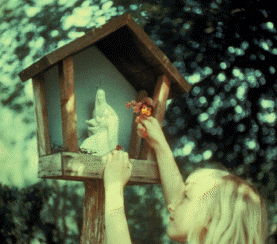
"I think I'll give this
one to Our Lady"
(Note Manger Straw Nest,
woven by birds)